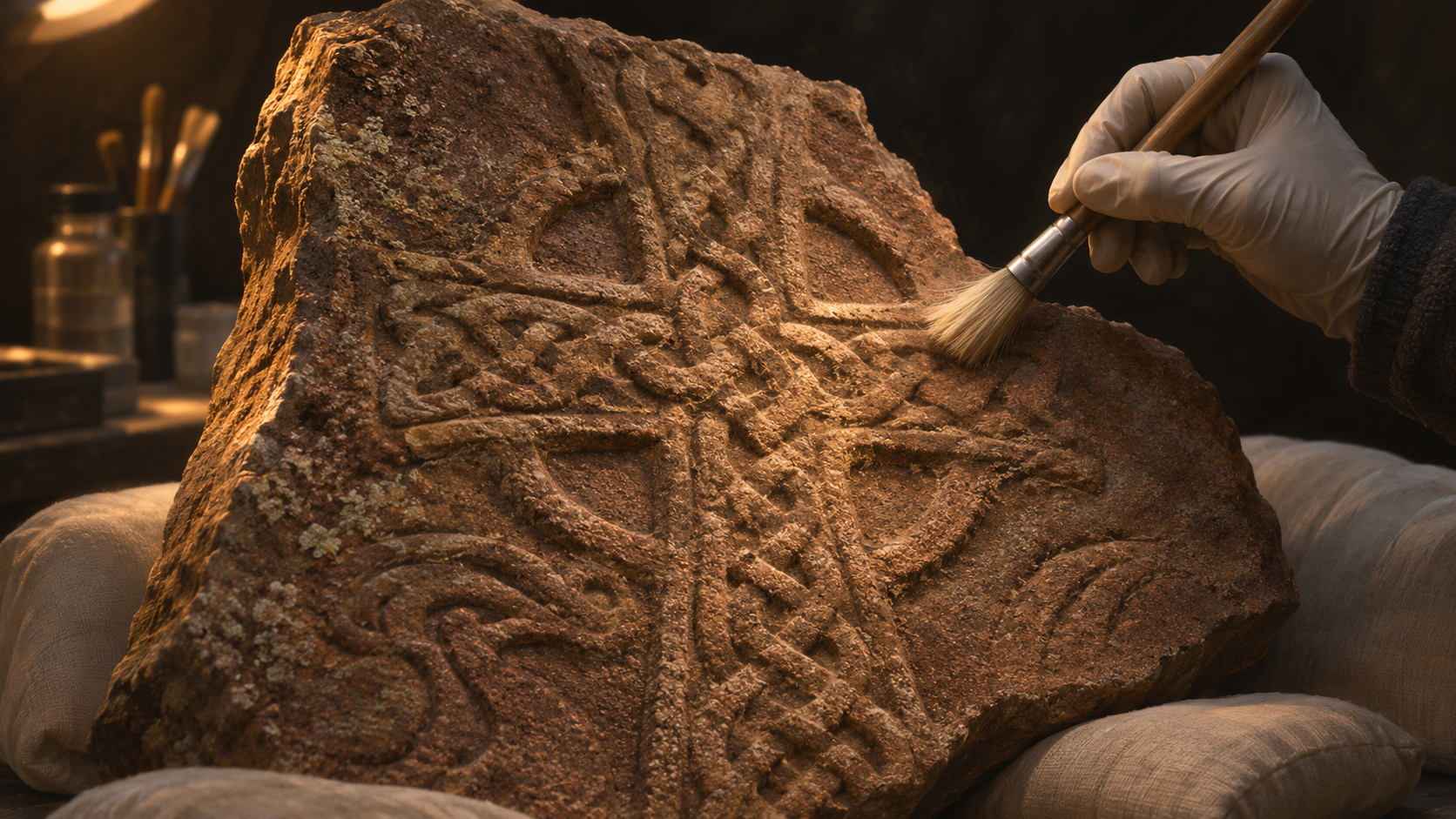
AI-generated editorial illustration by PW; not the actual monument or discovered fragments.
A carved face has emerged from an excavation at Aberlemno in Angus, Scotland, without an obvious monument to call home. Its original setting remains unknown, raising the possibility that the surrounding ground preserves more of its story.
Historic Environment Scotland’s November 5 announcement reports two discoveries by HES and AOC Archaeology: a fragment bearing a possible salmon motif beneath the base of Aberlemno III, and a relief-carved head in surrounding topsoil. HES says the head does not appear to fit the surviving slab or any known local Pictish monument. Its possible early medieval date still needs research.
See the actual find: HES’s release includes a photograph of the carved head. The artwork above is a conceptual conservation scene, not an image of that object.
Why archaeologists were working here
According to HES’s history of the site, Aberlemno III and its protective winter box fell in March 2025, probably during exceptionally strong winds. The stone was moved to Edinburgh for conservation. The work includes condition assessment, digital recording, excavation and scientific analysis to guide its future care and return.
This is the roadside cross-slab, carved on all sides. HES identifies a cross, worshipping angels, Pictish symbols, a hunting scene and David fighting a lion among its imagery. Those details place it within a landscape where older symbolic traditions and Christian imagery can be studied together. It should not be confused with Aberlemno’s separate churchyard stone and its battle scene.
Two contexts, two different questions

The fish-bearing fragment was being used to support the base. That points to reuse, but dating the sequence requires further analysis. The head presents a different problem: identifying a sculpture whose original setting is presently unknown. Finding both nearby does not, by itself, establish that they belonged together.
For readers following the discovery, the useful distinction is between an object’s appearance and its archaeological context. A recognizable face can draw attention immediately; the circumstances of its burial or reuse may tell the more consequential story. A fragment can survive long after the structure that first displayed it has been altered or dismantled.
What would move the story forward?
The most useful follow-up would connect the fragments to securely dated material, establish a physical match with another carving, or explain the sequence of changes at the site. Those findings could turn an isolated face into part of a larger, datable monument.
For now, the head’s missing context is what makes this discovery worth following. The next stage of research may reveal who made it, where it stood and how it ended up separated from the rest of its sculpture.
Leave a Reply