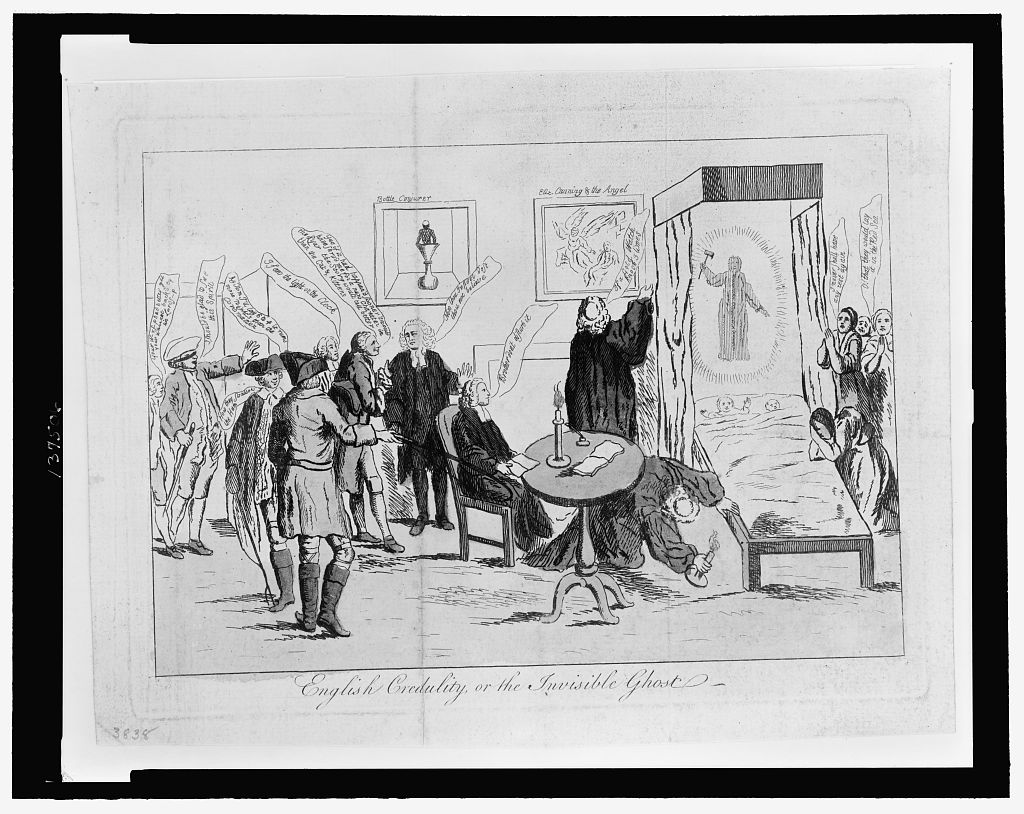
English Credulity, or the Invisible Ghost (1762). Contemporary satire, not an eyewitness record. Library of Congress, Prints and Photographs Division. No known restrictions on publication.
The ghost had supposedly agreed to a test. It would knock on its own coffin.
On the night of February 1, 1762, a group investigating London’s Cock Lane haunting went to the vault at St John’s, Clerkenwell, to listen. Nothing knocked. That mattered because the supposed spirit hadn’t just been keeping people awake. It had accused a living man of murder.
One knock for yes, two for no
The noises centered on Elizabeth Parsons, a twelve-year-old who lived in her father Richard’s Cock Lane house. The family had previously taken in William Kent and Fanny Lynes. After Fanny died, the scratching and knocking returned. Parsons and a local preacher, John Moore, took the noises for messages from her.
As Dr Johnson’s House recounts, they used a simple code: one knock for yes, two for no. The answers supposedly said Kent had poisoned Fanny with arsenic. Her death had been attributed to smallpox. There was already a dispute between the men: Kent had lent Parsons money and was suing to get it back.
London’s papers ran with the story. Crowds flocked to the lane, and according to Dr Johnson’s House, Parsons charged visitors to hear the ghost. The nickname that stuck was “Scratching Fanny.” The Wellcome Collection’s contemporary account preserves eight issues of the London Chronicle from those weeks, along with two engravings.
What the investigators heard
The account reproduced by the Samuel Johnson Birthplace Museum describes an uneven night. Some of the women beside Elizabeth’s bed reported noises while the investigators were downstairs. The party went to the vault for the promised knock. They heard nothing there.


In later tests, the noises stopped when Elizabeth’s hands and feet were kept in view, the museum says. Dr Johnson’s House also recounts a later séance in which she was reportedly seen slipping a piece of wood beneath her clothes. The period diagram shows the room and a board associated with the case. It isn’t a record of exactly how every sound was made.
The verdict was for conspiracy, not murder
By July, the people on trial weren’t the man the ghost had accused. Parsons, Moore and others were convicted of conspiracy. Parsons got two years in prison.
The knocking had sounded convincing enough for people to repeat a murder allegation. Nobody had shown that the person giving the answers was Fanny Lynes. The simplest test of that claim, a knock where she said she’d be, produced silence.
Read next

“Help Me” at Eastern State: Revisiting Paranormal Warehouse’s EVP
Hear a recording from a separate investigation and see what an ambiguous sound can tell you.
Leave a Reply