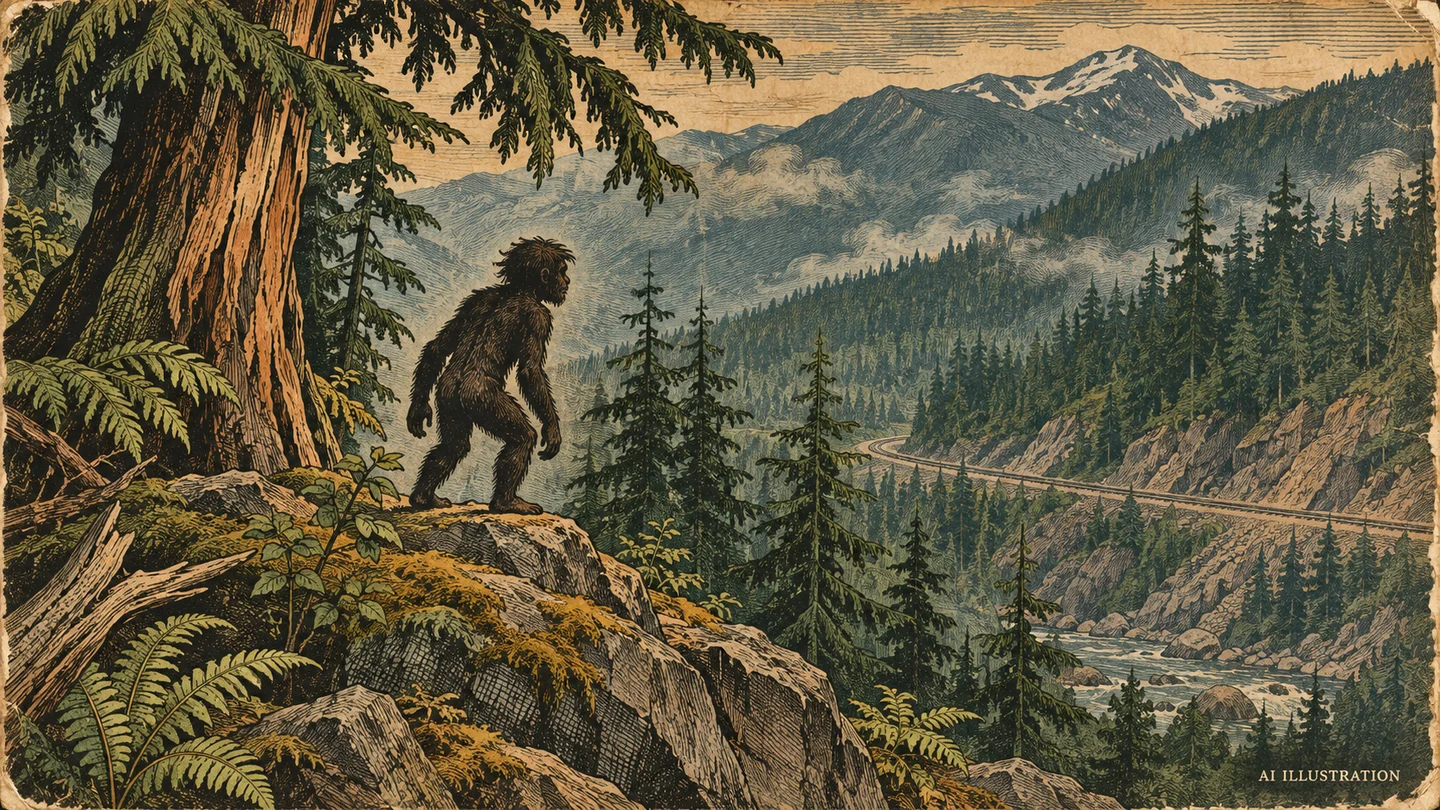
AI editorial illustration of the newspaper account. No verified photograph of Jacko is known.
The newspaper gave the creature a name, a weight and even a keeper. Jacko was said to stand four feet seven inches tall and weigh 127 pounds. George Tilbury, the man reportedly looking after him, was supposed to take him to London. That’s an unusually specific story about a creature no one can point to today.
It ran on page three of Victoria’s Daily Colonist on July 4, 1884. The report said railway workers and passengers climbed the rocky bluffs near a tunnel above Yale, British Columbia, and captured a small, dark-haired figure. Later retellings folded Jacko into Bigfoot lore. The original sounds nothing like a report of a giant in the woods.
What the newspaper put in print
The headline asked, “What is it?” The correspondent described Jacko as resembling a gorilla and said he could twist a stick apart. But the weight, the feat of strength and the plan for London all came from the same account. A named keeper gives you someone to look for in other records. It doesn’t tell you whether anyone independently saw the animal.

Look at the year under the headline
The issue is dated July 4, 1884. The line directly below the headline reads “Yale, B. C., July 3rd, 1882.” You can see both on the full page. The paper doesn’t explain the mismatch, so the dateline alone can’t establish the date of the reported capture.
The location is less tidy than it sounds, too. The correspondent put the No. 4 tunnel about twenty miles above Yale. An 1881 railway photo catalogued by Vancouver Public Library identifies a No. 4 tunnel two miles above the village. That doesn’t settle whether both sources meant the same tunnel. It does make the newspaper a poor basis for pinpointing the spot.
What survives of Jacko
The story also speculated about whether the captive was an Indigenous person, in dehumanizing language. That’s part of how the paper framed the story, not evidence about who or what was allegedly seen.
There’s no verified photograph, examination or exhibition record in the sources behind this account. The archive does give us something specific: the story as readers encountered it in 1884, right down to the wrong-looking year. A century of retellings can’t turn that page into a specimen.
Read next

What the searchers found at Ape Canyon
Two 1924 newspaper reports show how another famous Bigfoot story changed as people went looking for evidence.
Leave a Reply