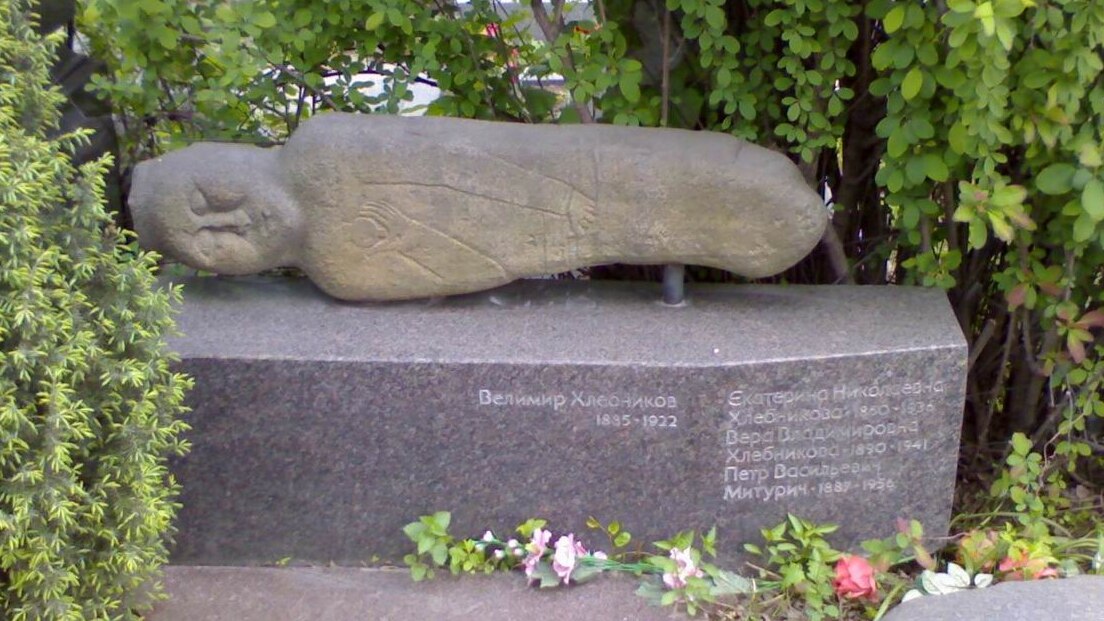
The stone figure on Velimir Khlebnikov’s grave in Moscow. Photo: Stasa16 / Wikimedia Commons, CC BY-SA 3.0, cropped.
The face on Velimir Khlebnikov’s grave isn’t his. On top of the poet’s monument at Moscow’s Novodevichy Cemetery lies a carved stone figure, its hands wrapped around a vessel. A photograph taken in southern Siberia in the 1950s shows what might be the same figure standing upright near a row of stones.
It’s not just the face that looks familiar. There’s a chip in the headgear, and the measurements come within a centimeter.
The clues are in the chip and the belt
In the 1950s, archaeologist Aleksandr Grach documented a carved figure near Sagly in southern Tuva. It stood beside a stone enclosure associated with 100 upright markers called balbals. The figure measured 1.17 meters, just under four feet. Grach recorded the width of the shoulders, the height of the face and the thickness of the stone.
State Hermitage researcher L. S. Marsadolov took those measurements to the Moscow cemetery in July 2025. In his published study, he says the numbers for the two carvings agree to within one centimeter. He also points to the same-looking chip in the headgear, the position of the hands around the vessel, and details of the belt and weapons. He considers it likely that the two photographs show the same figure.

The story of how it got there is less tidy
Khlebnikov wrote a poem about a stone figure in 1919. According to archaeologist Georgy Fyodorov’s 1975 account, the poet’s nephew and the poet Boris Slutsky wanted an ancient carving for his grave. Fyodorov said his colleague Leonid Zyablin found one near a mountain lake, where little more than its crown stuck out of the ground. The sculpture was installed in Moscow in late 1974, by Fyodorov’s account.
That story doesn’t name Grach’s site. The Hermitage said the carving in Grach’s published photograph had never entered its collection and that it had no reliable information about the origin of the grave marker. The measurements make a good case for a match, but neither the photograph nor the paperwork says who moved the stone from Sagly, if that’s where it came from.
What the stone stood beside
In a separate November 2026 field update, archaeologists described early Turkic memorial complexes elsewhere in Tuva with stone enclosures, carved figures and rows of upright balbals. Some rows stretch east for hundreds of meters. The survey didn’t trace the Moscow stone. It does show what’s missing when you see a figure alone on a plinth: the arrangement of stones it was meant to stand beside.
Read next


The monster carved onto a king’s ship
Another old carving, this time from a shipwreck, and what it can tell us about where it came from.
Leave a Reply