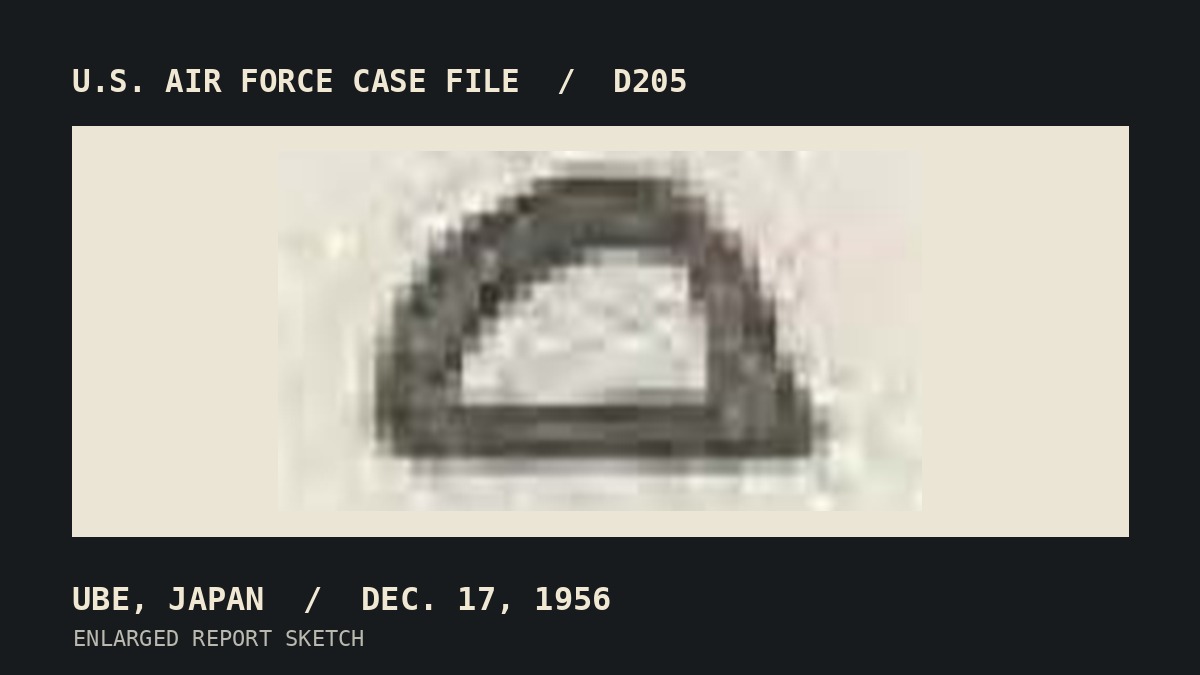
Enlarged sketch of the reported object, not a photograph. U.S. Air Force report IR-12-57, page 2.
Lt. R. N. Brumet was supposed to be tracking one jet. The other F-86D belonged to his wingman, and the pair were practicing intercepts near Ube, Japan. Then a second mark appeared on Brumet’s radar, bigger than the one he was expecting. Ground control didn’t have a matching target, so he asked if he could take a look.
It was December 17, 1956. The Pentagon included the Air Force report in its November 20, 2026 release. The full scan includes a tiny drawing of what Brumet described: a rounded top and flat base, a little like the end of a pencil eraser held up against the windshield.
One radar saw it. The others didn’t.
The second return showed up at about 20 nautical miles. When Brumet’s scope put it at eight, he said he saw something in the same direction. He described it as golden tan with no metallic glint. The report says the radar return lasted seven to eight minutes and he saw the shape on and off for three to four.
Brumet got within roughly five nautical miles, according to the debrief. His scope showed interference, but it didn’t lose its lock at that point. His wingman, Lt. R. A. Sneary, picked up Brumet’s jet but not the same target. Ground sites reported no unidentified tracks. The report notes the ground station was already relying on the fighters’ identification signals to track them, so its lack of a return isn’t a clean test of what was in the air.

The speed wasn’t measured
The report estimates the departure at 1,500 to 1,800 knots after the mark moved rapidly off the top of the scope. It also says that was beyond what the radar could directly indicate for a target pulling away. The number was an estimate of a moving mark, not a measured speed of the object Brumet saw.
The Project Blue Book case card treats those as two different things. It calls the radar mark a false return and assesses the visible object as a weather balloon. That’s the Air Force’s explanation, not a confirmed match to a specific balloon. The drawing shows why Brumet wanted a closer look. It can’t tell us whether the shape he saw was what his radar had been tracking.
Read next

What happened after the Kinross radar tracks drew together?
In a separate 1953 intercept, a ground controller saw two tracks close in over Lake Superior.
Leave a Reply