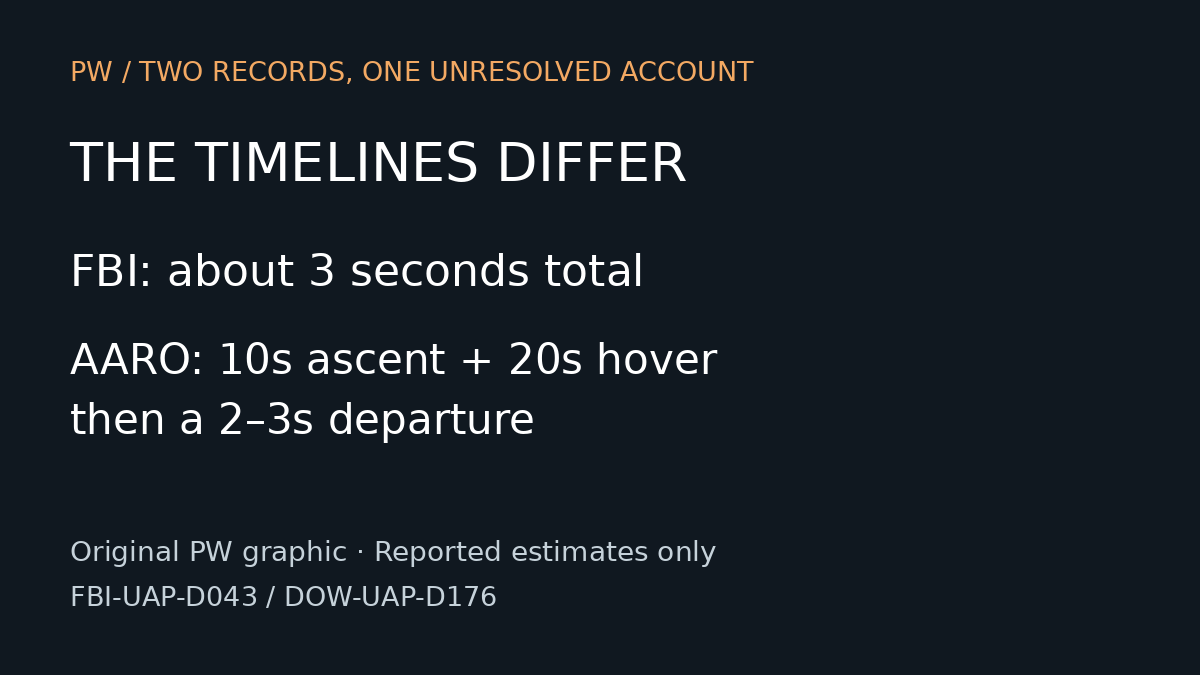
Featured image: Original PW comparison graphic based on the released records. Reported estimates only; not footage or a reconstruction.
A black triangular object rises above a ridge, appears silent to the people watching, then disappears into a canyon. That is the broad account preserved in two government records released in October 2026. Read them side by side, however, and an important detail stops lining up: how long the encounter lasted.
PW’s Facebook overview of the seventh UFO-file release included the triangle report. This closer review concerns the records themselves, rather than treating the social post as corroboration. The discrepancy does not identify the object, but it affects how confidently anyone can reconstruct its movements.
What the FBI statement says
The FBI FD-302, FBI-UAP-D043, reproduces a statement co-signed by two agents. Another agent alerted them to a detection; they moved to obtain a view and described a dark triangle resembling a delta-wing drone. They estimated a wingspan of nine to fifteen feet.
One agent reported viewing it through a handheld thermal device. The statement describes an ascent above a ridge, a transition into rapid horizontal movement and a descent out of view. On PDF page 2, it gives approximately three seconds as the total duration of the sighting. No sound was reported.
AARO describes a longer sequence
The AARO witness-debrief memorandum, DOW-UAP-D176, divides the account into three phases: an ascent of about ten seconds, a hover of roughly twenty seconds, and a departure lasting two to three seconds. Those intervals describe a substantially longer sequence than the FBI statement’s total.

Other details also vary. The FBI statement records approximately 1923 hours, while AARO gives 2023L. The FBI wingspan estimate begins at nine feet; AARO’s begins at thirteen. Neither difference should be silently corrected by choosing whichever version makes the story more dramatic.
A discrepancy is a question, not a verdict
One possibility is that the shorter duration refers to the final movement rather than the entire observation. Another is a recording, recollection or transcription problem. Those are hypotheses, not explanations established by the documents. The FBI wording explicitly describes the total sighting, so changing its meaning requires evidence.
The useful next step would be a clarification identifying which interval each witness meant, how the accounts were recorded and whether any contemporaneous timestamps survive. Redactions limit that comparison. A reader should not be asked to accept a seamless timeline where the available records do not supply one.
What remains unmeasured
AARO’s memo explicitly says no instrumented speed measurement was obtained. Its opening caution also frames the descriptions as the reporter’s interpretation, rather than conclusive findings about the object’s features or performance. That matters when claims of extreme acceleration are repeated as though they came from calibrated tracking data.
An official record establishes that an account was documented. It does not automatically establish the identity of the subject. Likewise, a disagreement between accounts does not by itself prove deception or resolve the event as an ordinary aircraft. The responsible position is narrower: preserve the report, identify the differences and avoid turning estimates into measurements.
PW assessment: An unresolved witness account with a material timing discrepancy. The records justify further questions, not a confirmed identification or propulsion claim.
Source note: We inspected the PDF scans of FBI-UAP-D043 and DOW-UAP-D176 through UAP.GLOBAL’s mirrors. Both files matched that host’s published SHA-256 checksums. The government FBI-file link and government AARO-file link returned access errors during this review. The graphics are original PW summaries, not government illustrations.
Leave a Reply