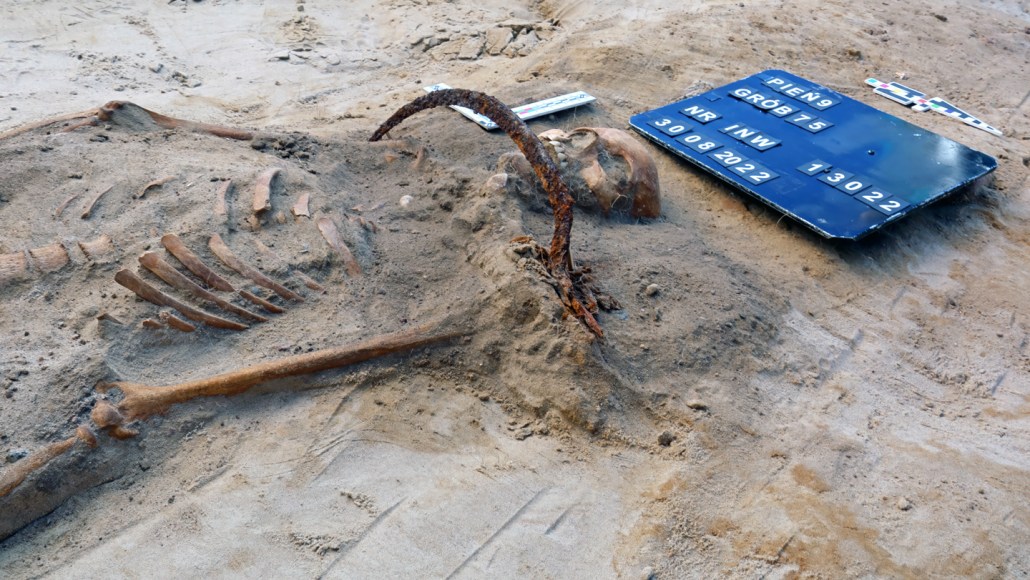
Excavation photo: Łukasz Czyżewski, Poliński et al. (2026), CC BY 4.0.
A rusted sickle curved over her throat. A triangular padlock hung from the big toe of her left foot. Four centuries after a young woman was buried at Pień, in north-central Poland, those objects remain powerful evidence of an extraordinary burial—and an incomplete explanation of what happened to her.
Now researchers are taking another look at her bones. In an October 29 update from Science in Poland, archaeologists with TSE Ewolucja described renewed examinations using equipment at Nicolaus Copernicus University’s Institute of Veterinary Medicine. They are focusing on the ribs and breastbone and comparing other unusual burials from the cemetery. The update announced continuing work, not a solved cause of death.
What was actually found
Archaeologists discovered grave 75 in 2022. The multidisciplinary study first published online on July 30, 2026 combines excavation evidence with skeletal, genetic, isotope and textile analyses. It estimates that the woman died at 17–19 years old. “Zosia” is a name given to her after the discovery; her historical identity remains unknown.
The sickle’s blade faced the throat. The padlock was recovered open, although the researchers conclude it had originally been closed and its mechanism was later damaged. They could not determine exactly when that damage happened. Neither observation establishes that the woman was executed, injured with the sickle or restrained this way while alive.
The authors interpret the arrangement as protective practices intended to limit the dead person’s perceived ability to harm the living. They also stress that explanations of the community’s motives rely on comparisons with other burials and historical beliefs. The objects survived; the people who placed them left no account explaining this particular grave.

Was the grave opened a second time?
Mixed soil layers, an irregular grave outline and the position of the left arm suggest a later disturbance. The researchers propose that someone may have reopened the burial and added the sickle as another precaution. Because much of the skeleton remained connected, they suggest any such reopening could have happened before the body had fully decomposed.
That is a reconstruction of events, not a witnessed sequence. The grave’s condition supports the possibility of intervention, but it does not reveal who returned, precisely when, or what prompted them.
A person behind the “vampire” label
Surviving silk decoration contained silver and gilded silver threads. The researchers regard the elaborate head covering as evidence of relatively high social status. It complicates an easy picture of an impoverished outsider rejected by everyone around her.
Her origins are uncertain too. Mitochondrial DNA suggests a possible maternal connection to Scandinavia, among other plausible origins. Tooth-isotope results fit the Pień region, but overlap with other European regions. The study explicitly cautions that neither method can pinpoint her origin alone. The evidence does not establish that she herself was a foreign-born stranger.
What the new tests still need to answer
The open-access paper found no traumatic injury or skeletal condition that explained her death. The October update says researchers are investigating anomalies and possible pathological changes in the ribs and breastbone. It does not identify a confirmed disease or demonstrate that illness caused the unusual treatment.
Documented: a young woman’s remains, distinctive burial objects and physical traces that may indicate later disturbance. Unresolved: her cause of death, the exact burial sequence and why the community treated her this way.
“Vampire” is a modern shorthand for interpreting fear of the dead. This grave offers evidence of what people may have feared, not proof that their fear was justified. The next meaningful advance will be a published finding that helps explain the woman’s life and death without allowing the label to become her biography.
Leave a Reply