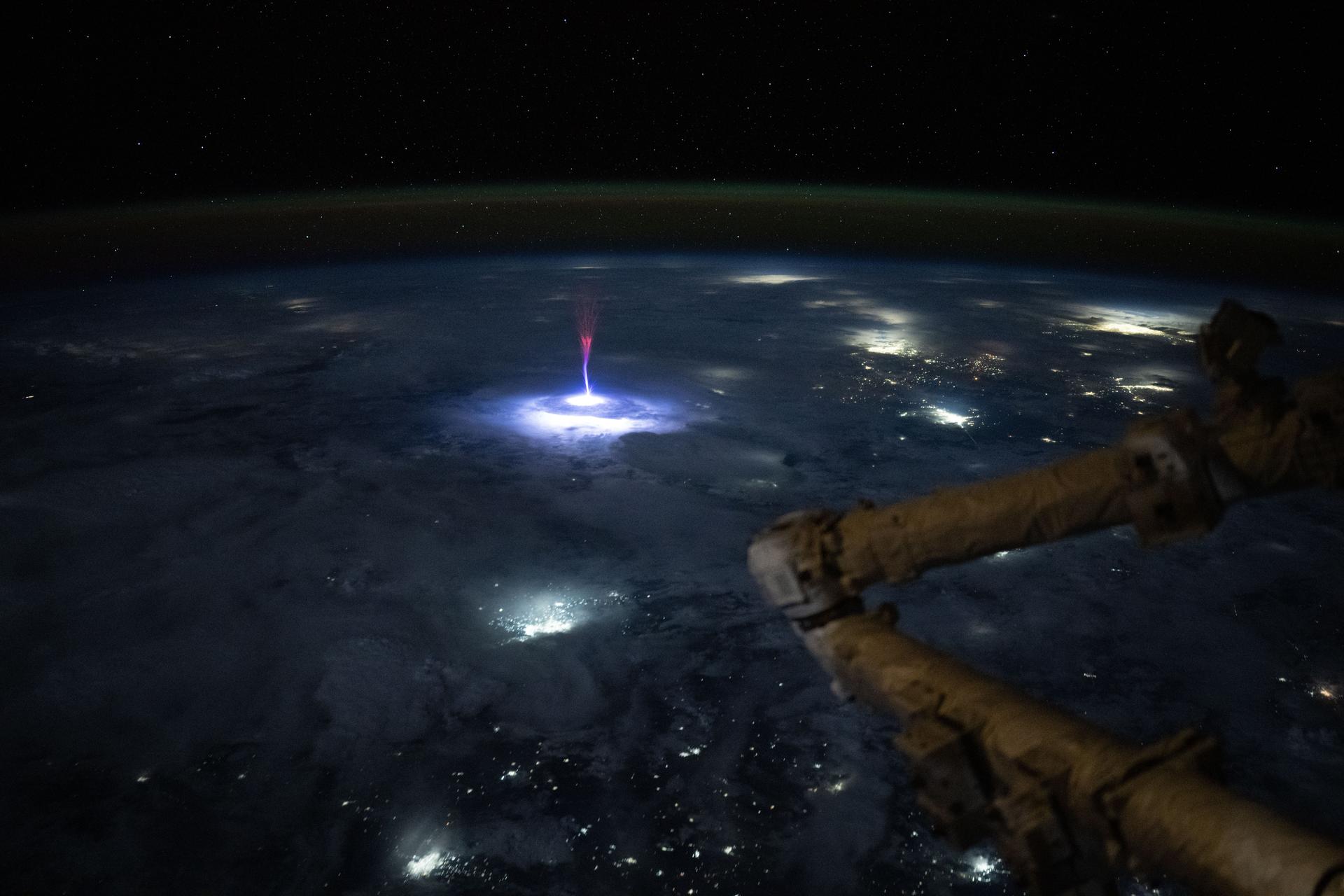
Gigantic jet photographed from the International Space Station, July 3, 2025. NASA/Nichole Ayers.
The storm is below. The light is going the other way.
In a July 3, 2025 photograph from the International Space Station, a bright thread shoots up from the clouds and fans into red against the dark. NASA astronaut Nichole Ayers caught it with Earth’s thin green horizon behind it and a piece of the station in the foreground. You can follow the flash right back to the storm.
It was initially described as a sprite. NASA later identified it as a gigantic jet. Both can look red from orbit, but the direction the light seems to point isn’t the best clue. Look at where it starts.
Lightning takes the upstairs exit
A gigantic jet grows upward from the top of a thundercloud. The discharge can stretch into the ionosphere, the electrically charged part of the upper atmosphere. A sprite forms much higher than the cloud, often after a powerful lightning strike below. It can hang above the storm like a red jellyfish or show up as a cluster of narrow columns.
That’s why the thin connection to the cloud is worth looking for in Ayers’ picture. Color alone doesn’t tell you how a flash formed, and a photo from one angle doesn’t show every part of the discharge. But put this shot next to NASA’s photograph of a sprite, and the difference is a lot easier to see.
Find the red flash next to the Moon
In the second photo, the faint red mark is just left and below the bright Moon, above a blue-lit storm near the horizon. The Expedition 44 crew took this one on August 10, 2015, looking northeast from above northwestern Mexico. NASA places the sprite high over Missouri or Illinois, roughly 1,400 miles from the station when the crew took the picture.

The first sprite camera wasn’t looking for sprites
People reported odd flashes above storms long before anyone got a good look at one. In 1989, University of Minnesota researchers were testing a low-light TV camera for an upcoming rocket mission when they happened to record one. The flash was finally something researchers could go back and watch.
The name for this whole family is transient luminous events. The important word is transient. Some are so brief that the sky has gone dark by the time you look up. NOAA describes another kind called ELVES: expanding rings of light that can stretch hundreds of miles across and disappear in less than a thousandth of a second.
Knowing the name doesn’t make the photo any less strange. A thunderstorm sent a discharge up instead of keeping it in the cloud, an astronaut happened to be looking, and even the first label needed a second look.
Read next

Florida’s November 8 fireball
This separate flash came from an asteroid fragment. NASA traced its path with witness reports, cameras and satellites.
Leave a Reply