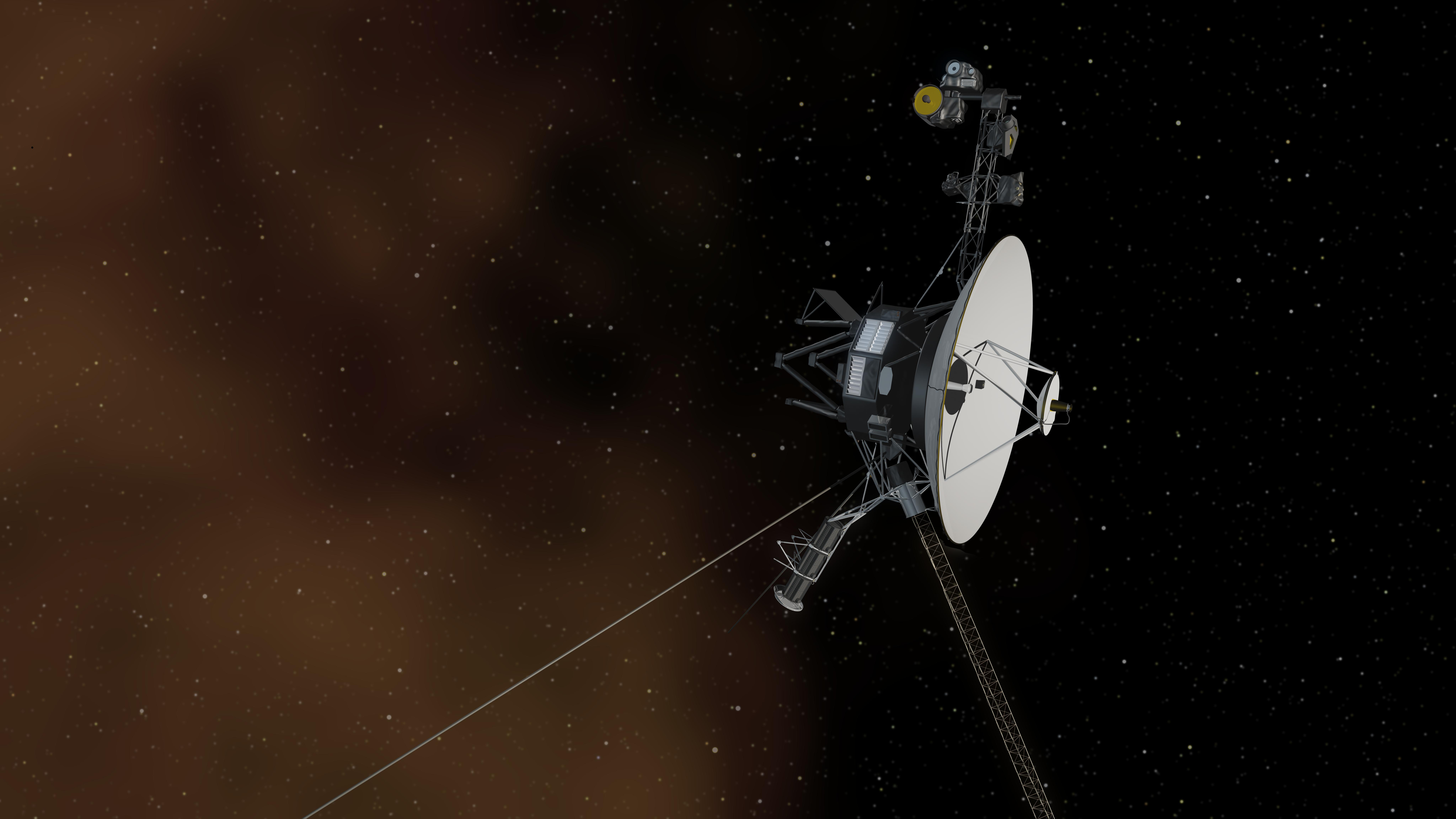
Artist’s concept of a Voyager spacecraft. NASA/JPL-Caltech. Not a photograph.
If NASA says hello to Voyager 1 on Wednesday, the spacecraft won’t hear it until Thursday. If it could answer right away, Earth would still be waiting until Friday. That’s how far out this thing has gotten.
NASA expects Voyager 1 to reach one light-day from Earth on November 18, 2026. That’s about 16.1 billion miles. It launched in 1977, flew past Jupiter and Saturn, and entered interstellar space in 2012. Nearly half a century after launch, the most distant object we’ve ever built can still call home. It just takes a while.
There’s no fast way to ask what went wrong
One light-day measures distance, not how far Voyager travels in a day. Radio waves cross that gap at the speed of light, just like visible light. A command takes about 24 hours to get there, and the spacecraft’s reply spends another 24 hours on the way back. That’s two days just to see whether a command did what you wanted.
In October, NASA missed Voyager 1’s signal during two scheduled listening attempts. The signal came back on October 20, before engineers sent a troubleshooting command. They found that the spacecraft had switched to backup thrusters, but NASA’s October 29 report didn’t pin down what caused the communications pause. NASA listens with the Deep Space Network, whose giant dishes can pick up faint signals. A bigger dish can hear better, but it can’t make the signal get here sooner.

Four watts at a time
Power is the other thing the team can’t get back. Voyager turns heat from decaying plutonium into electricity, and NASA says each probe loses roughly four watts of available power a year. In September, engineers turned off three devices on Voyager 1 and turned on lower-power alternatives. They had to make the swaps together to keep heat distributed where the spacecraft needed it.
That bought extra time for the remaining science instruments. Voyager 1 is past the heliopause, the boundary where the solar wind gives way to the interstellar environment. What it measures out there comes from a spacecraft actually traveling through that region, not a telescope looking at it from Earth. Turning off an instrument is a real trade, not just a way to save on the electric bill.
How to mark a day of distance
NASA’s public plans start Tuesday, November 17, with a symbolic after-dark signal. A phone can flash Voyager’s call sign in Morse code, but the flash isn’t how the team talks to the probe. On Thursday, November 19, JPL is hosting a mission discussion at noon Eastern, with viewing details at NASA Live.
Voyager won’t feel a thing when it crosses the line. Nothing switches on, and nothing new appears outside the spacecraft. Back here, the distance has become something you can picture: send a message, sleep on it twice, then check for an answer.
Read next

Euclid’s blue arcs and the light that made them
Voyager sends radio waves back to Earth. Light carries information about much more distant places, too, even when gravity bends it along the way.
Leave a Reply